 Phone: +9830138837
 Email: skillhubpublication@gmail.com

Author
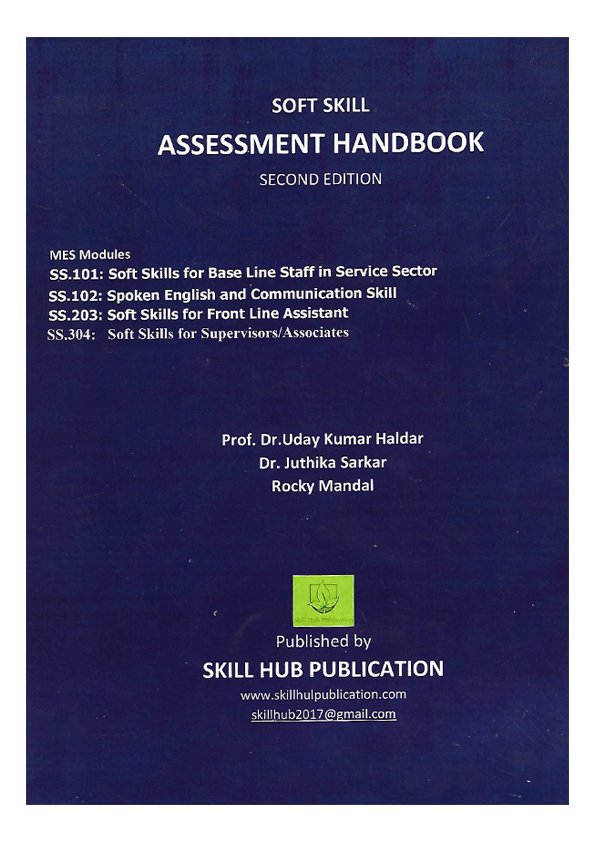
Soft Skill
(1)
‘Soft skills’ are alternatively known as ‘People Skills’. This skill comprises some personal attributes. Soft skills are interpersonal and broadly applicable across all job titles and industries. Achieving Soft skills enhance an individual’s capacity of interactions, career prospects, and job performance. It stand established that knowledge of ‘Soft Skills’ is critical to enhance positive relations among employees of all levels. A person with in-depth knowledge of soft skills is likely to be successful in all types of organisations in multiple job roles.
‘Soft skills’ are alternatively known as ‘People Skills’. This skill comprises some personal attributes. Soft skills are interpersonal and broadly applicable across all job titles and industries. Achieving Soft skills enhance an individual’s capacity of interactions, career prospects, and job performance. It stand established that knowledge of ‘Soft Skills’ is critical to enhance positive relations among employees of all levels. A person with in-depth knowledge of soft skills is likely to be successful in all types of organisations in multiple job roles. This reading material has been developed considering the backgrounds of vocational candidates. Any person intending to know and develop soft skills will find this reading material extremely useful. This material has been developed based on the syllabi of DGT/DGE&T. It is needless to mention that this material is first of its kind. This material is meant for the students, trainers, assessors, VTP/VTC officials, and other readers. Teachers would find this material useful to set questions for internal tests. Appearing in such tests would enhance the confidence of the trainees. Teachers are requested to discuss the students with their answer scripts and highlight the loopholes. This material covers the syllabi of the modules SS.101, SS.102, SS.203 and SS.304. QP and QP with answers for SS.101 and SS.102 are included in this handbook. The syllabi of SS.203 and SS.304 indicate that these two modules are for advanced levels. For these two modules questions and answers are given. We have not included MCQs and picture identification in these two papers of SS.203 and SS.304. Answers of MCQ, identification of pictures, matching of sentences are given at the end of this material. Answers of some short answer questions and hints of few long answer questions are given. We are reiterating that in the classroom the teachers should give assignments. On receipt of the responses of the assignments the teacher should preferably discuss the students. The reading material ends with syllabi of the four modules of the Soft Skills sector. The mistakes and omissions detected by us have been attended to. We are extending our gratitude whoever pointed out our oversights. We believe that improvements are never ending. As such, we would appreciate suggestions for further improvement of this reading material. Readers could contact us at the email given below. We do request the readers not to reproduce this material in any form.